Stakes, Weather, and Second Chances: A Field Guide to the Campaign Sign
Every campaign has its unglamorous machinery: the call sheets, the walking lists, the coffee that goes cold before the first door is knocked. And then there is the yard sign—the most visible, least understood piece of the operation. It appears on a lawn as if by magic. It disappears just as quickly when the season turns. In between, it lives a secret life of volunteer labor, local rules, weather, repair, and responsible cleanup.
That life is worth understanding, because a sign is more than decoration. It is a small public statement by a private property owner, a visible sign of neighbor-to-neighbor support, and a test of whether a campaign can execute ordinary logistics with care. This year, as the 2026 campaign moves from the front lawn to the storage bay, here is what happens between the garage and the curb—and how supporters can help do it right.
From a Garage Floor to a Stakes-and-Bands Kit
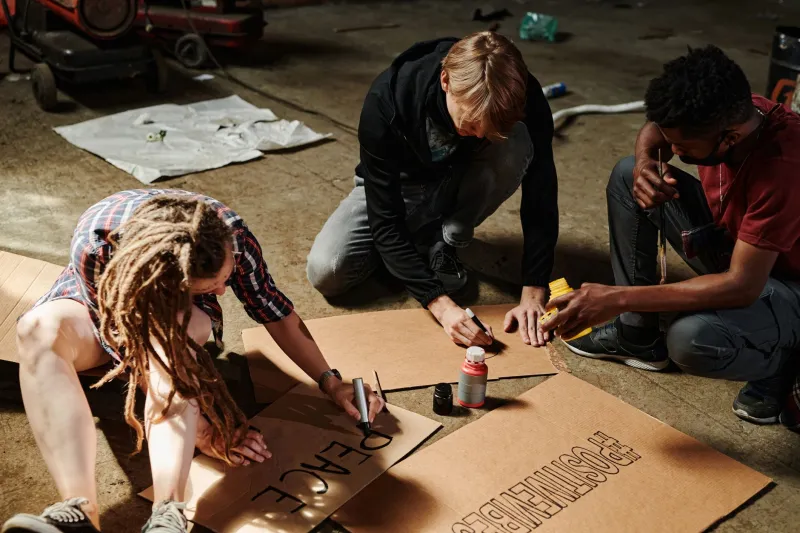
A sign begins as a stack of flat panels and a bundle of metal stakes. On assembly nights, volunteers gather around long tables to sort, inspect, and pair them. The work is simple but not trivial. Panels with cracked flutes are set aside. Stakes are checked for bent tips and missing safety caps. Bands are counted so that each kit can be handed to a volunteer without a second trip to the supply bin.
The best assembly nights run on a precinct map, not guesswork. Teams bundle signs by neighborhood so that distribution routes make sense. A volunteer who lives near the county line should not be sent across the district to pick up five signs for a street he can see from his porch. Good logistics respect time, fuel, and the volunteer who has already given up a Saturday morning.
This is also where the campaign's standards begin. Every sign must carry the required disclaimer. Every kit must be clean enough to represent the campaign well. And every volunteer should leave knowing the two rules that matter most: ask before you plant, and never assume a public strip is a free-for-all.
The Rules Are Local, and They Matter
Yard sign placement is governed by a patchwork of local ordinances, homeowners association covenants, and plain neighborly courtesy. Some communities restrict signs in public rights-of-way. Others prohibit them on utility poles, traffic signal boxes, or medians. Many enforce sight-distance rules near intersections. A few require removal within days after an election.
A serious campaign does not treat these rules as obstacles to be ignored. It treats them as the ordinary terms of local self-government. Property rights begin with permission: a sign belongs on private property only when the owner has said yes. Public space is not a loophole; it is a trust, and it should be used only as local law allows.
Volunteers are therefore trained to ask three questions before a sign goes into the ground. Is this private property, and has the owner agreed? Does the location comply with local rules and HOA standards? Will the sign block a sidewalk, obscure a driver's view, or create a hazard? When the answer to any question is uncertain, the right move is to check with the campaign office or leave the sign for another location.
What Wind, Rain, and a Careless Truck Teach a Campaign
A sign that looks sturdy on a calm afternoon can be flat by morning. Wind is the great equalizer. Soft ground after rain lets stakes lean. A delivery truck clipping a curb can snap a stake at the base. A mower throws grass and gravel. Weather is not an emergency; it is a maintenance schedule.
Experienced volunteers push stakes deep enough to hold, orient panels to reduce wind load where local rules permit, and avoid placing signs where runoff will pool. They keep a small repair kit in the truck: extra stakes, zip ties where allowed, a rag, and a few replacement panels. They also keep a list of high-traffic locations that need a second look after a storm.
This unglamorous follow-up is part of what makes a grassroots campaign credible. A faded, crooked, or abandoned sign does not persuade anyone. A neat line of signs, placed with permission and maintained with care, tells a neighbor that the people behind the campaign are attentive to small things. That reputation travels farther than any single piece of plastic.
When a Sign Disappears
Sign theft happens in every cycle, and it is always disappointing. The proper response is neither confrontation nor theatrical outrage. It is documentation and replacement. Volunteers note the location, the date, and any pattern. They report the loss to the campaign and, when appropriate, to local authorities. Then they replace the sign if the budget and the law allow.
A missing sign is not a mandate, and a stolen sign is not a movement. It is usually a nuisance, occasionally a crime, and always a reminder that campaigns should not become too attached to any single symbol. The work is the conversation at the door, the record on the ballot, and the neighbor who decides to host a sign because she trusts the people who asked.
Supporters can help by keeping an eye on signs in their own neighborhoods and by reporting damage rather than attempting a confrontation. Calm stewardship is more persuasive than anger, and it keeps volunteers focused on the tasks that actually move a campaign forward.
The Second Life of Corrugated Plastic
After the election, the sign's secret life enters its final chapter. Corrugated plastic is durable, which is good for a campaign season and inconvenient for a landfill. Many municipal recycling programs do not accept it at the curb. The responsible options are to reuse panels, return them to the campaign for storage, or deliver them to a collection point that accepts the material.
Metal stakes are usually recyclable and should be separated from the panels. Bands and zip ties should be removed and disposed of properly. Volunteers can organize retrieval routes by ZIP code, much as they organized distribution. A few hours of pickup in November can save a garage full of clutter and keep campaign materials out of the waste stream.
This is not glamorous work, but it reflects a principle conservatives understand well: stewardship is what happens after the enthusiasm fades. We should leave the district as clean as we found it, and we should treat every donated dollar and every donated hour with the same care.
An Invitation to Stewardship
If you are asked to host a sign—now or in a future cycle—say yes if you can do so lawfully and cheerfully. Place it on your own property with permission, keep it tidy, and take it down when the season ends. If you can help assemble, distribute, or retrieve signs, volunteer for a shift. The campaign needs drivers, sorters, map readers, and people willing to check a route after a windstorm.
And if you are not able to host a sign, you can still help. A contribution of any size buys stakes, panels, and bands. A few hours of your time keeps the operation moving. Most of all, your neighborly example sets the tone for a campaign that is visible without being careless.
The yard sign will never be the most important thing a campaign does. But it is one of the most visible. Done well, it says something modest and true: that our supporters are organized, our volunteers are serious, and our campaign respects the communities it asks to represent.